Decide on your hardware before the cabinets are painted. If new knobs or pulls need different holes, the old ones have to be filled and sanded flat before primer goes on, and new holes are drilled. Make that call after painting and you are patching fresh paint. Hinges are the same: whether you keep them, replace them or switch to a different kind changes what happens to the doors.
Knobs to pulls
Switching from knobs to pulls is one of the most common changes people make along with paint, and the most common reason for filling holes.
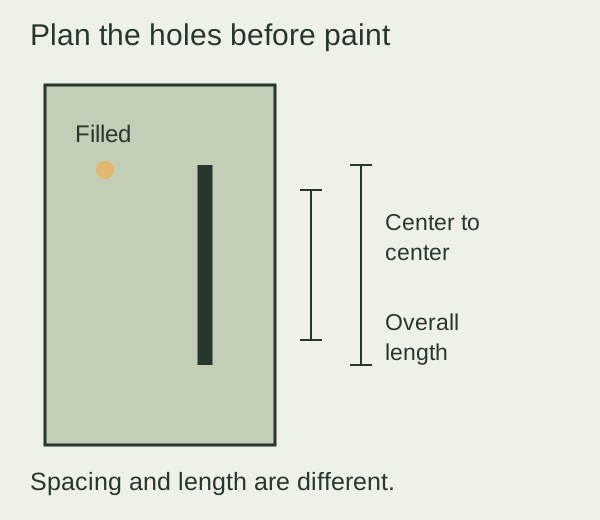
- A knob uses one hole. A pull uses two. Moving from a knob to a pull means filling the knob hole and drilling two new ones, unless the pull can be centered over the old hole with both new holes clear of it.
- Pull size is measured center to center, the distance between the two screw holes, not the overall length. Common sizes are 3 inches, 96 mm (about 3 3/4 inches) and 128 mm (about 5 inches).
- Swapping pulls for pulls is easiest when the new ones have the same center-to-center spacing as the old ones. Then nothing is filled.
- Filled holes disappear under paint when they are filled and sanded properly. That is one of the advantages of painting over staining: a filled hole in stained wood always shows.
Keeping your hardware
If you like your knobs or pulls, keep them. Brushed nickel, black and simple brass hardware work with most cabinet colors. Clean them while the doors are off: warm water and dish soap for most finishes, then dry them completely.
Don't paint your hardware to match. Painted knobs and hinges chip quickly, because they are touched and moved every day and metal doesn't hold paint the way a primed door does. If the finish on the old hardware is worn, replacement is usually inexpensive compared with the rest of the job.
Exposed hinges on 1990s face-frame cabinets
Many oak kitchens from the 1990s have hinges you can see from the front: a small metal plate on the face frame and another on the door, often in brass or antique finish. Once the cabinets are painted, those hinges tend to become the most dated thing in the kitchen. You have three choices:
- Keep them. Clean them and put them back. This is the cheapest option and works if you like the look or are painting to sell.
- Replace them with the same footprint. New exposed hinges in black or nickel that fit the same screw holes and the same door overlay. This changes the look without changing the doors.
- Convert to concealed hinges. Concealed hinges, the kind that sit inside the cabinet, need a round cup bored into the back of each door and a mounting plate on the frame. It is a bigger change: the doors are drilled, the old hinge screw holes on the door front are filled, and the door may sit differently on the frame. It gives the cleanest look.
Soft-close
Slamming doors are a common complaint in older kitchens. There are two ways to add soft-close:
- Add-on dampers. A small damper mounted inside the cabinet near the hinge, or clipped onto a compatible hinge, slows the door before it closes. They work with some existing hinges, and you can add them to just the doors that slam.
- New soft-close hinges. A hinge with the damper built in. On face-frame cabinets, hinge makers publish which hinges and adapters fit which frame and overlay. Blum, for example, makes its COMPACT BLUMOTION face-frame hinge with the soft-close inside the hinge and lists it as interchangeable with its standard COMPACT hinge.
Check the maker's compatibility information against your hinge and overlay before ordering. A hinge that doesn't match the overlay will leave the door sitting wrong on the frame.
Why painted hinges fail
You may see hinges that were painted along with the cabinets in a kitchen that was painted before. They rarely look good for long. Paint on a hinge cracks at the knuckle the first time the door swings, glues the hinge so the door drags, and chips at the screw heads. Hinges come off before painting and go back on clean, or they are replaced.
Door bumpers, drawer slides and the little things
- Door bumpers: The small clear or felt dots on the back of doors. Old ones get dirty and hard. New ones are cheap and quiet the doors.
- Drawer slides: If a drawer sticks or drops, the slide is worn. Replacing slides is separate from painting, but it is easiest to do while the drawer fronts are off.
- Catches and latches: Magnetic and roller catches on older cabinets can be cleaned or replaced.
- Screws: Stripped hinge screw holes are common in older face frames, and they can be repaired before painting so the doors hang straight.
Who buys the hardware and who installs it
Decide this before the job starts. Many homeowners choose and buy their own knobs and pulls, because it is a style choice. Have the hardware in the house before work begins, and make sure the quote says who drills the new holes and who installs the hardware. If you are not changing hardware at all, say so, and the old holes are left as they are.
Measuring guide
Before you buy new hardware:
- Count every door and drawer that needs a knob or pull. Order a few extra.
- Measure the center-to-center spacing of any pulls you want to replace with the same size.
- Note the overlay of your doors if you are replacing hinges: how much the door covers the face frame on the hinge side. Hinges are sold by overlay.
- Take a photo of your current hinge, front and back, to compare with what you order.
- Measure the drawer front height if you are switching to cup pulls or long bars, so the pull fits.
Our scope guide covers everything else you should list in a quote request, and the cost guide shows how filling old holes affects the price. For the full picture of a finished job, see Leavenworth kitchen cabinet painting.
Changing hardware? Tell us when you ask for a quote
Note the hardware you have, what you want to switch to, and whether you want hinges changed.